Friday, May 20, 2011

Off to the Field

Development workers know this phrase all too well: “I’m off to the field!” What exactly does 'the field' mean? No, it doesn’t mean that you’re off to have a picnic in a field. Although, I guess it could if you really wanted it to. Technically it means going to do work in the project areas. What does going into the field mean for me? Well, in Nepal, it means lots and lots of driving. Usually, there’s also some walking, flying, and maybe even horseback riding if you’re lucky. Other than seeing the program areas, going into ‘the field’ allows me to see the other side of Nepal, the one outside of Kathmandu. Since Kathmandu is the only major city, I think it’s safe to say that there are two walks of life here: urban and rural. Going into the field means 'going rural'.
Recently, on a trip to the very hot Dang district in the Mid West, I started wondering about local life. Yes, it often means sleeping in mud huts, battling the elements, and eating lots and lots of dahl baht. But, I thought, there must be something else. So I asked the blunt question, “what do people do in Dang?” Thus, I did some digging. Trying to stay culturally sensitive, I asked the occasional question like, “what do you do in your spare time?” Usually the answer was three-part: "eat, spend time with family, and rest". Not satisfied, I pressed harder. Yet, I still got the same answers. In return people just asked me when I was getting married. Trying to dodge a handful of bullets, I dropped my quest.
It looks like in Dang, people do have lots of time to spend with family and well, sit around. I guess that’s what happens when you believe in reincarnation. No need to rush when you’ve got more lives to live. The first few days, I found I was very antsy. Then, slowly, the days passed quickly whilst sitting around. Not only did I get to ponder my inner workings but I also started to appreciate the slow paced nature of rural life. Alas, now back in my urban persona, antsy reigns supreme. I do however get to sit at my desk and think about the next time I get to tell people “I’m off to field!”

Tuesday, January 25, 2011

You Come, You Know, Nepal


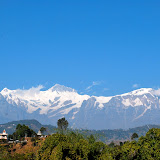
2011 marked the start of Nepal Tourism Year. Thus, in an attempt to follow suit, I finally took some of my own obligatory tourist shots. Go ahead, click the Annapurna Mountain Range above.

This year, along with catchy slogans such as the title of this post, also brought with it some friends and family members. Family has the ability to make you feel strong and yourself and yet also regress into your weaknesses, your former life in close proximity with your family. Either way, getting to show people close to you all you've been experiencing over the last however many months is one of the best feelings there is.

NYE Pokhara

An 8 hour bus ride to the mountains. A lake nestled below the Annapurna Mountain Range, reaching 8000 meters. New Year's Eve in Pokhara. Watching the paragliders fly over the lake, jumping from mountain to peak. A motorcycle ride away from the center of town, seeing how the locals live, farming, breathing in the fresh air. The lake flows into local rivers, their rocks are used to build bridges. On the lake, boats to a Hindu temple island, beggars wait nearby. Back in town, a street food festival, a sampling of Nepali and Western cuisine, overrated. Nepali men out at night, drinking, having a good time. Spending time with friends, out at night, having a good time. Counting up to a new year. Happy 2011.

Friday, December 17, 2010

Language Lisp

A little while ago, a Nepali friend passed on some words of wisdom. "You know, a lot of words in English are Nepali words". Hearkening back to my Indian experiences, I remember a few words that the British picked up whilst in India, namely jungle, shampoo, and pajama. My Nepali friend however, conjured up a few I'd never thought of before. These include words like T-shirt, jacket, traffic jam, and vehicle. I stood there for a moment, deciding the best course of action to take. Do I, as more or less a native English speaker, tell him that these words are English and not Nepali? Or, should I go into the history of English influence in India which then spread to Nepal resulting in English usage for Western influences? Or, do I not say anything all? I opted for the latter: nothing.

Later, I found myself wondering, what is it about languages and their power to determine how we describe the world around us? No, not in an anthropological/sociological way but more in terms of who gets ownership of word usage. He and I have both grown up using the words jungle, shampoo, pajama, T-shirt, jacket, traffic jam, and vehicle. We have probably seen, interpreted, and used these words in very similar ways. So, it seems we're stuck in a lingual samsara, cycle, using and reusing our words over and over again, making this whole notion of ownership, well redundant. Ultimately, this brief internal monologue sprung a new debate. Whty did something like this bother me in the first place? Why even care? Then, alternatively, if I care so much, why didn't I open up the discussion with my Nepali friend. Perhaps, I have been living in other cultures too long, having learned that people will believe what they believe and do not always want or need to be corrected or challenged. Perhaps, as I've now seen, my culture is slowly blending in with other ones, making it difficult for me to answer the question, "why?" Rather than coming up with another conclusion starting with "perhaps", I'd rather go on enjoying life's ideosyncraties and abosrbing myself in this neverending lisp.

Wednesday, October 27, 2010

Terai of a Realization

Another weekend, another field visit. Heading back west, I flew an hour and a half on a very questionable aircraft, conjuring up the necessity of silent prayer before take-off and landing. Arriving in the heat of the Terai, the plains, I got in the car and began my assignment. My trip took me to the East and West of the districts of Kailali and Kanchenpur, either bordered by rivers or India or both. Overall a whirlwind of a weekend of dust, sand, and the ever illustrious meals of dahl baht.

Driving along the bumpy road and covering my mouth from the clouds of dust pluming from the jeep's wheels, I started thinking, what happens when one becomes blind to the stratification of society?
After about 1 1/2 days of driving, I had neglected to notice even the slightest air of poverty around me. Yet there I was, meeting with flood victims and former bonded labourers, seeing their mud and straw homes, and listening to their stories of not having anything at all. Rather than thinking of their poverty, I found myself thinking of the horror that none of these people could swim, despite the fact that rivers are their lifelines. Sitting in my comfortable neo-colonial-esque jeep, I tried to come to terms with my quandry. Stepping on a boat that was more like a raft and even more like a barely floating child's tree house, I laughed to myself as I was experiencing yet another bizarre Nepali situation, which for everyone else is merely local transportation.

Having returned to Kathmandu on the same ever-so-questionable aircraft and happy to be alive, I've pondered my musings. In short, life is life and people are people. Poverty, riches, and questionable public transportation just fit into the seams. Similarly, smiles are smiles, tears are tears, and although we may all seem very different, everything may not always be as it seems. Rather than clarifying my altered vision and indulgence of wordy prose, I'm going to keep enjoying the fact that I may have walked on Nepal's only beach, the sand left over from a flood on the banks of a river, and someone's home.

Thursday, October 21, 2010

A Lang Tang Story

In order to get the true feel of a one-week trek I just completed in the area of Lang Tang, I have decided to share it through my photos. In the group of eleven I was with, all of us have seen our fair share of unusual and amazing sights. Thus, to walk in a place where every single person repeatedly said, "WOW!" must bear some weight. In summation, you hike a lot and eat momos, dahl baht, and sherpa stew in little wooden guest houses where you also sleep. Oh yeah, and the 60 mile bus ride there took 10 1/2 hours. I invite you to click Lang Tang mountain above to see some of the things I saw.

Sunday, October 10, 2010

Wild Wild West

I recently had the chance to channel my inner cowgirl and head out to the wild West of Nepal. Going out into the field for a week was a wonderful combination of amazing views and a whirlwind of experiences. These are some of my stories:

A woman and her baby barged into my room asking if I was God and could give her salvation. Not sure about that one. Was told it was common practice to tinkle off of your staircase after 11pm. Went on two planes, two 10 hour car trips up windy mountain roads, and two 6 hour hikes, the first of which was done in flip flops and the second which included a horse named Moti (Pearl). Was charged by a cow and was told I am the only vegetarian foreigner in the whole world. Speaking of which, was also the first foreigner seen by most local residents. This resulted in thousands of snickers, dozens of namastes, and three crying babies. I had the pleasure of hanging out with 6 middle-aged Nepali men whose idea of a perfect vacation was, "staying at home, having friends over, gambling, smoking, drinking beers, and having our wives and daughters serve us." Additionally, over the span of six days, ate 18 meals of dahl bhaat (rice with lentils) and was lucky if I saw one toilet every 24 hours (a squat one mind you!), one of which was not even a toilet but a 'women's area' located in a field of thorn bushes where I was told I was welcome to have "a short or long sit".
Despite this whirlwind of hilariously questionable activities, I did have the chance to meet some wonderful people who have really made the best of very difficult lives. The average life expectancy for women in this region is 35, as they are the ones who perform manual labor, take care of the house and the children, and are the ones solely responsible for the entire family's well being. Meeting some of these women, many of whom were infected or affected by HIV as a result of their husbands, with smiles on their faces, a positive outlook, and living well past 35 was a truly humbling experience. This was the first time I saw that many families live without even basic foods such as fruits and vegetables, eating only rice and ramen noodles. This trip, I admit, was truly an eye opening experience.
Yet, for these Western residents, having family members and friends love you no matter what outweighs any and all hardships endured. Duly noted. Thank you wild wild West.